Selecting an aluminium spout pouch supplier involves more than comparing unit prices. Buyers must assess barrier performance, spout and cap compatibility, seal integrity, print quality, and production consistency. These details matter. A pouch may look excellent on a sample table yet fail during filling or transport.
Market context explains the growing attention. Grand View Research estimated the global flexible packaging market at USD 266.7 billion in 2023 and projected a 4.8% compound annual growth rate from 2024 to 2030. The estimate covers flexible packaging broadly, not spout pouches alone. The OECD’s Global Plastics Outlook reported that packaging generated about 40% of plastic waste in 2019, reinforcing the need to examine material choices carefully. Sustainability claims still need scrutiny. A laminate’s recyclability depends on its structure and available collection and processing systems; supplier wording alone is not proof.
This guide compares ten suppliers for global buyers, focusing on practical evidence: technical specifications, sample testing, documented quality systems, customization options, and communication across export orders. Request written data on oxygen and moisture barrier performance, seal testing, and material composition. Confirm that test conditions match your product and filling process. A single specification sheet cannot answer every question. No supplier is automatically the best fit: order size, destination, product sensitivity, and lead time can change the decision. The comparison aims to make those trade-offs visible, while recognizing that public supplier information may be incomplete or outdated.
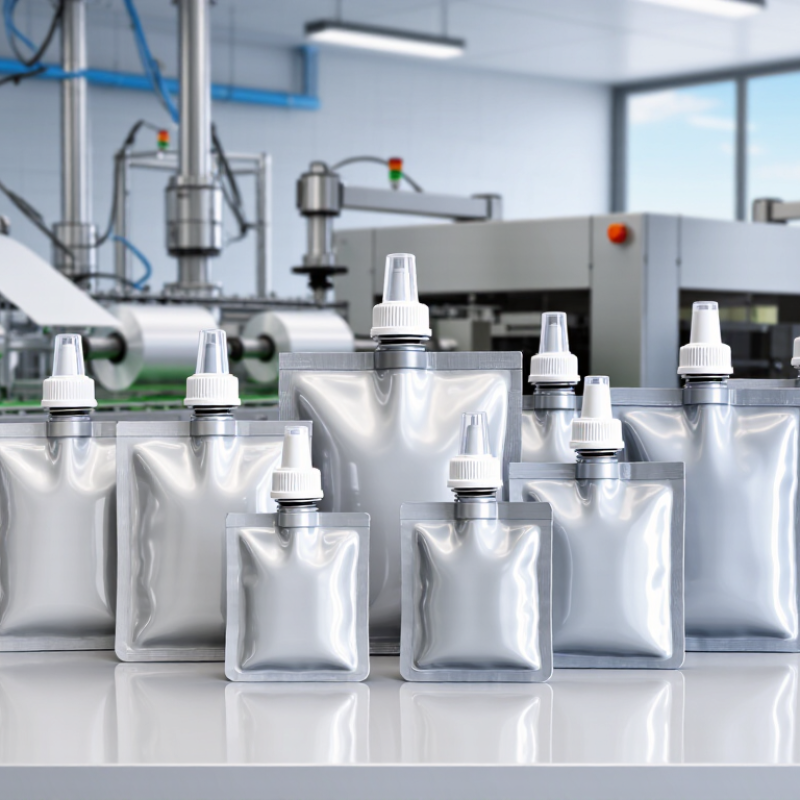
An aluminium spout pouch is a flexible package with a pour spout and screw cap. Its layered film may include an aluminium foil or metallised barrier layer. This helps limit exposure to light, oxygen, and moisture, depending on the pouch construction. The spout is sealed to the pouch, while the cap can be opened and closed between uses. Small details matter: a narrow opening controls flow, while a wider one may suit thicker contents.
These pouches are used for pourable products such as sauces, drinks, purées, and personal-care liquids. They are light to carry and take up less space than many rigid containers. A resealable cap can also help reduce spills after opening. Not every pouch suits every product. Buyers should check material compatibility, filling temperature, seal strength, and cap performance with the actual contents. A pouch that looks sturdy may still leak if its fitment seal is weak.
The format has trade-offs. Multi-layer construction can make recycling difficult where suitable collection systems are unavailable. Barrier performance also varies, so suppliers should provide specifications and test results rather than broad promises. In a practical trial, check for leaks after transport, confirm that the pouch pours cleanly, and assess whether users can grip it with wet hands. It is not perfect packaging, but careful testing can reveal problems before a large production run.
For international sourcing, assess an aluminium spout pouch supplier beyond its catalogue. Compare pouch dimensions, laminate structure, spout position, and seal width against your filling-line requirements. Ask for written material specifications and recent test results. A sample should match the production version, not just look convincing on a desk.
Check how the supplier handles quality checks, lead times, and shipping documentation. Request details on seal-integrity testing and how defects are recorded. Confirm production capacity, sample timelines, and shipping terms in writing. Ask which destination-market requirements the materials and documents are designed to support. Then verify those details with your own technical or compliance team. A polished sample can still hide inconsistencies between batches. That is easy to overlook.
Tips: Send a filled pouch through your actual filling and handling process. Note leaks, awkward spout placement, and cap fit. Request a corrective-action plan if results vary. Small details matter. Also discuss what happens when schedules slip; vague answers deserve a follow-up. A supplier may sound confident and still need clearer evidence.
A practical supplier shortlist should compare capabilities, not polished claims. Supplier 1 specializes in custom pouch sizes and can advise on spout placement. Supplier 2 focuses on high-volume production, where stable lead times matter. Supplier 3 offers flexible small-batch runs for product testing. Supplier 4 provides matte and gloss finishes, useful for shelf presentation. Supplier 5 emphasizes strong seals and leak testing. Ask for sample pouches filled with a similar product.
Supplier 6 supports multiple spout sizes, including options for thicker liquids. Supplier 7 offers printing support and checks color consistency between runs. Supplier 8 focuses on recyclable or reduced-material structures, but request clear technical details before comparing claims. Supplier 9 serves buyers needing coordinated shipping and export documents. Supplier 10 may suit projects requiring close design collaboration. These are supplier profiles, not endorsements; actual equipment, quality systems, and service vary. A sample can look convincing, yet perform differently after filling. That detail is easy to miss.
Tips: Share your filling temperature, product viscosity, target volume, and expected order size before requesting a quote. Confirm barrier specifications, seal strength, spout fit, and delivery terms in writing. Compare like with like. Ask how defects are recorded and resolved. One caveat: testing takes time, but skipping it can cost more later.
Global primary aluminium production increased from 63.7 million tonnes in 2019 to 70.6 million tonnes in 2023. This industry-wide trend provides raw-material context for buyers evaluating packaging suppliers; it does not compare individual suppliers.
Source: International Aluminium Institute (IAI), global primary aluminium production statistics. Figures are rounded to one decimal place.
A capable aluminium spout pouch supplier should do more than print attractive samples. Buyers can compare laminate options, pouch sizes, spout positions, and filling-line compatibility. Ask for seal-strength results and barrier data for the intended product. A small detail, such as a cap that is awkward to grip, can affect daily use.
Certifications help, but their scope matters. Check whether quality-management certificates are current and cover the actual production site. For food-contact packaging, request relevant test reports and confirm they match the materials being quoted. Ask how traceability works, from incoming film rolls to finished pouches. Details matter. A tidy audit file can still leave practical questions unanswered.
Markets also shape supplier fit. Export experience may help with language requirements, shipping documents, and regional packaging expectations, but it is not proof of compliance. Ask suppliers to explain their usual lead times, minimum order quantities, and support for print revisions. Request a recent production sample, not just a polished sales mock-up. Compare answers in writing. One limitation is easy to miss: smaller suppliers may offer flexibility but have less backup capacity during busy periods. A careful buyer should weigh that risk against price and responsiveness.
Choosing among the top aluminium spout pouch suppliers starts with the product, not the sales presentation. Send each candidate the same brief: pouch dimensions, laminate structure, thickness, spout diameter, filling temperature, and target shelf life. Request a current specification sheet and samples from a normal production run, not just a polished prototype. Small details matter. A cap that loosens after repeated opening can undermine an otherwise well-made pouch.
Review test reports and quality records, checking that they match your exact pouch structure and intended use. For products requiring food-contact suitability, request relevant declarations and supporting test data for the destination market. Ask how the supplier checks seal strength, leak rates, and print registration. Recent batch records are useful, even with confidential details removed. Verify the factory address, business credentials, and customer references. If practical, arrange a site visit or independent audit.
Compare written quotations carefully. Clarify minimum order quantities, lead times, tooling ownership, change control, and complaint handling. Then run a pilot order and inspect pouches for leaks, uneven seals, and difficult-to-use spouts. Keep the results; memory gets unreliable. No checklist removes every risk, and a tidy sample is not proof of consistent production. A supplier’s response to a specific problem can be as revealing as its sales pitch.
Use this evidence-based checklist to compare suppliers. It is not a ranked supplier directory; confirm all certificates, test results, and commercial details directly with each candidate.
| No. | Evaluation Area | What Buyers Should Verify | Evidence to Request | How to Assess the Result |
|---|---|---|---|---|
| 1 | Food-contact compliance | Whether the pouch, spout, cap, inks, and adhesives are suitable for the intended product and destination market. | Material declarations, test reports, and a written compliance statement identifying the applicable market and intended use. | Check that documents cover the complete packaging structure and actual use conditions. Requirements differ by material and market; no single certificate covers every application. |
| 2 | Migration testing | Whether migration testing is appropriate for the product type, contact conditions, and target-market rules. | Recent laboratory reports that identify the tested sample, test conditions, methods, and results. | Confirm the tested construction matches the offered pouch, including the spout and closure. For EU markets, assess applicable food-contact rules, including Regulation (EC) No 1935/2004 and relevant material-specific measures. |
| 3 | Quality management | Whether production and quality processes are documented and consistently controlled. | Current ISO 9001 certificate, if held, plus the certificate scope and issuing certification body details. | Verify the certificate’s validity and scope with the issuer or accreditation directory. ISO 9001 is a quality-management-system standard, not a product-safety approval. |
| 4 | Packaging-site certification | Whether the manufacturing site has a relevant packaging or food-packaging safety certification required by the buyer. | Current certificate, site address, scope, audit date, and certification-body information; examples may include BRCGS Packaging Materials where applicable. | Confirm that the named site and product scope match the pouch production being quoted. Certification schemes and buyer requirements vary. |
| 5 | Barrier and laminate construction | Whether the proposed layer structure and barrier performance suit the product’s sensitivity to oxygen, moisture, light, or aroma loss. | Layer-structure specification, material data, and relevant oxygen-transmission or water-vapor-transmission test reports. | Compare results against product shelf-life needs and test conditions. Do not assume every aluminium-containing pouch has the same structure or barrier performance. |
| 6 | Seal, leak, and pouch integrity | How the supplier controls seal strength, spout attachment, leakage, and finished-pouch consistency. | Documented inspection methods, acceptance criteria, sample test records, and batch quality records. | Test production-representative samples with the buyer’s filling process and product. Agree on measurable acceptance criteria before ordering. |
| 7 | Spout and cap compatibility | Spout diameter, cap fit, opening and pouring performance, and compatibility with filling equipment and product viscosity. | Dimensioned drawings, material specifications, closure details, and physical samples. | Check fit and operation on the intended filling line. Evaluate the actual product, since viscosity and particulates can affect dispensing. |
| 8 | Traceability and change control | Whether materials and finished goods can be traced by production lot and whether changes are communicated before implementation. | Sample lot codes, traceability procedure, change-notification process, and recall or withdrawal procedure. | Ask the supplier to demonstrate a mock traceability exercise and identify how affected batches would be located. |
| 9 | Commercial capacity and delivery | Quoted minimum order quantity, production lead time, available capacity, shipping terms, and contingency arrangements. | Written quotation, production schedule, capacity statement, and agreed delivery terms. | Compare like-for-like specifications and order quantities. Treat lead times and capacity as order-specific, and confirm them in the purchase agreement. |
| 10 | Samples, printing, and sustainability claims | Sample approval process, print-color controls, artwork management, and substantiation for any recyclability or environmental claims. | Pre-production samples, approved artwork proof, color-control procedure, and supporting documentation for environmental claims. | Approve a production-representative sample before release. Check sustainability claims against the pouch’s complete material structure and the rules in the sales market. |